|
Back to Knee Topics
A total knee replacement (TKR) or total knee arthroplasty is a surgery that resurfaces an arthritic
knee joint with a artificial metal or plastic replacement parts called the ‘prostheses'.
Doctors may recommend surgery for people suffering from severe arthritis in the knee to decrease
the pain and to improve the patient's ability to walk.
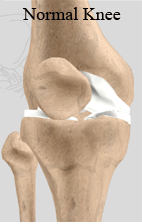
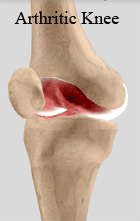
-
The cartilage lining is thinner than normal or
completely absent. The degree of cartilage
damage and inflammation varies with the type and stage of arthritis.
- The capsule of the arthritic knee is swollen
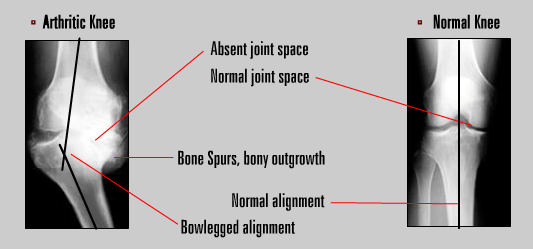
- The joint space is narrowed and irregular in outline;
this can be seen in an X-ray image.
- Bone spurs or excessive bone can also build up around
the edges of the joint.
The combinations of these factors make the arthritic knee stiff
and limit activities due to pain or
fatigue.
Diagnosis
-
The diagnosis of osteoarthritis is made on history, physical
examination & X-rays
There is no blood test to diagnose Osteoarthritis (wear & tear
arthritis)
A longitudinal skin incision is made down the front of your knee. This incision usually measures
around 15cm. The kneecap is reflected out of the way and the arthritic surfaces are removed. Soft
tissue releases are performed. Special instrumentation is used to remove the bone in a specified
manner so that a knee replacement prosthesis can fit onto the bone with or without cement.
Some prostheses do not require cement fixation and the bone grows into them. Other prostheses
require cement fixation. Your surgeon will decide which is the best fixation prosthesis for your quality
bone. Once the two metal components are fixed to the bone, a plastic insert is placed on the tibial surface. This plastic acts as the shock absorber. The plastic allows the low friction movement to occur.
The plastic may either be fixed or mobile depending on the type of prosthesis.
The kneecap may also require resurfacing depending on the amount of wear. This is done by
removing half the under-surface of the kneecap (patella) and cementing a plastic kneecap in its
place.
Soft tissue releases are performed to balance the knee joint and after the prosthesis has been
placed in the knee, the knee should appear straight and flex to over 110 degrees.
Many arthritic knees are bowed due to the arthritis. A total knee replacement will correct this mal-alignment. Some knees are knock-kneed and similarly the replacement will correct the mal-alignment. Following the surgery the wound is closed with absorbable sutures and a drain is inserted.
Post-operative physiotherapy is started after 24 to 48 hours. It is important to do all the exercises
as they will allow a quicker recovery. Quadriceps exercises and knee extension and flexion exercises
are most important. You should expect to gain a range of motion from 0 to 110 degrees. Very stiff
knees often do not regain this amount of movement. Knees that start off with 140 degrees of
movement may lose approximately 20 degrees of movement following the replacement.
As anybody undergoes general or regional anesthesia (epidural anesthesia) there are always risks associated with it. The risks of course are magnified if you have abnormal general medical conditions
in addition to your older age, which may have affected the functions of your vital organs such as heart, lungs and kidneys. Therefore a complete evaluation of those systems has to be performed before
you are taken to the Operating theatre.
- This is prevented by giving blood thinners and if it occurs it is
treated
with specific blood thinners, usually Warfarin.
- The risk of infection is less than 1% and pre-operative antibiotics are given
to
prevent this from happening.
- Occasionally knee replacement may stiffen up particularly in patients who
are significantly overweight or have diabetes. Occasionally one will require a manipulation
under
an anaesthetic should this occur.
- It is unlikely that any major nerve or vessel will be damaged.
It is unlikely that any major nerve or vessel will be damaged. It is, however, very common
to have
a small area of numbness over the other side of your knee where a superficial skin
nerve is
always cut during the surgery. This little numb patch is of no significance.
- The prosthesis may fail due to the plastic wearing out and it may require revision.
- Very rarely a condition can occur where the leg becomes
stiff, hypersensitive and painful. This requires specific treatment with a pain management specialist.
- This usually settles but may require drainage.
- Some skin will scar up significantly (keloid).
- Occasionally this may occur and require drainage.
It is usual
for knees to be a little swollen and a little warm.
- Kneeling may produce discomfort over the incision site.
A total knee replacement often takes at least six months to settle in.
|